“Stars” is a poem by Sara Teasdale that describes the beauty of a starry night sky. The speaker is alone on a hill surrounded by pines, above them the heaven is full of stars. As they watch the stars they feel honored to witness such timelessness and majesty. A short but beautiful poem about nature’s grandeur. Read an analysis of this poem at PoemAnalysis.

Stars

By Sara Teasdale

Alone in the night
On a dark hill
With pines around me
Spicy and still,

And a heaven full of stars
Over my head
White and topaz
And misty red;

Myriads with beating
Hearts of fire
The aeons
Cannot vex or tire;

Up the dome of heaven
Like a great hill
I watch them marching
Stately and still.

And I know that I
Am honored to be
Witness
Of so much majesty.

🎵 Buy track on Bandcamp
👩 Read a short biography about Sara Teasdale

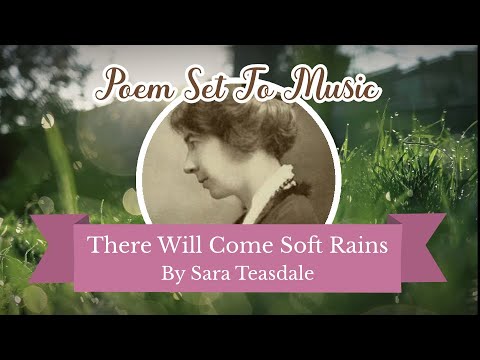
"There Will Come Soft Rains" is an anti-war poem by the American poet Sara Teasdale (1884 – 1933). It was publicized in 1918 during World War I and the 1918 flu pandemic and describes a harmonious world without human beings. Although the poem was written over a hundred years ago it will continue to stay relevant as long as mankind engage in war.

For nature the outcome of war is irrelevant, in fact if it wouldn't even notice if mankind disappeared altogether. Spring and her rejuvenating rain will come no matter what and the lives of the animals and plants will go on as usual. The frogs will sing in their pools, the swallows will fly and instead of fighting the robins will happily whistle their tunes on the wires. The power of the natural world will win over mankind’s destructive ways and peace shall come whether humans are still here or not. You can read a longer analysis of the poem at PoemAnalysis.com.

"There Will Come Soft Rains" is probably Teasdale’s most famous poem and has been set to music by other composers, this is my version. I had an idea for a melody and I happened to come across this poem and somehow they fitted together. The instruments in this song are a mix between software instruments and recorded tracks. For the percussion I recorded branches, sticks and stones in a forest.

There will come soft rains

By Sara Teasdale

There will come soft rains and the smell of the ground,
And swallows circling with their shimmering sound;

And frogs in the pools singing at night,
And wild plum-trees in tremulous white;

Robins will wear their feathery fire
Whistling their whims on a low fence-wire;

And not one will know of the war, not one
Will care at last when it is done.

Not one would mind, neither bird nor tree
If mankind perished utterly;

And Spring herself, when she woke at dawn,
Would scarcely know that we were gone.

🎵 Buy track on Bandcamp
👩 Read a short biography about Sara Teasdale

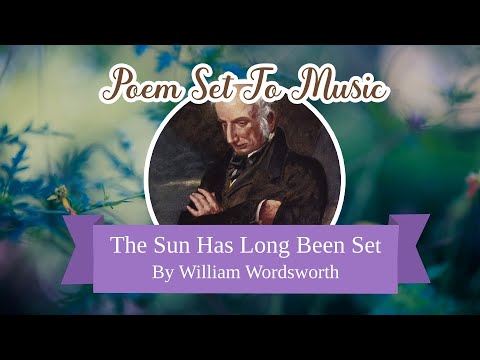
“The Sun Has Long Been Set” is a poem written by the British poet William Wordsworth (1770 –1850). The poem paints a beautiful and serene picture of a summer’s night in nature. Here we can be ourselves while enjoying the birds, trees, water and nightsky. Wordsworth suggests that the simple pleasure of being in nature surpasses that of a life in London.

I’ve only used a few instruments in this song; vocals, piano, guitar, strings and a celeste. I hope I managed to capture the poem’s peaceful feeling with the arrangement.

The Sun Has Long Been Set - Poem By William Wordsworth

The sun has long been set,
  The stars are out by twos and threes,
The little birds are piping yet
  Among the bushes and trees;
There’s a cuckoo, and one or two thrushes,
And a far-off wind that rushes,
And a sound of water that gushes,
And the cuckoo’s sovereign cry
Fills all the hollow of the sky.
  Who would “go parading”
In London, “and masquerading,”
On such a night of June
With that beautiful soft half-moon,
And all these innocent blisses?
On such a night as this is!

🎵 Buy track on Bandcamp
🧑 Read a short biography about William Wordsworth

“Under The Greenwood Tree” is a poem taken from William Shakespeare’s romantic comedy “As You like It”. In the play it’s a song sung by the character Amiens and urges the listener to move away from the busy life in court and settle for a simple and peaceful life in the woods. There they shall live from what nature has to offer, free from ambition and civilization. Read a longer analysis of the poem at InterestingLiterature.

You might recognize the title “Under The Greenwood Tree” since it’s also a famous novel published in 1872 by the English author Thomas Hardy. Read more about Hardy’s novel on Wikipedia.

All instruments in this song, except the vocals and the ukulele, are recorded in a forest near where I live. For the percussion I recorded stones, sticks and branches and the kick drum is a piece of bark that I banged against a tree. I think the sounds turned out nice and fit with the pastoral theme of the song. With all the stress and distractions in modern life isn’t there a part in all of us that long for the kind of simple life that this poem describes?

As You Like It

“As You like It” is a famous romantic comedy play by William Shakespeare. In the play a Duke has been exiled from the French court by his younger brother Frederick. The Duke’s daughter Rosalind is first allowed to stay at court but is later banished by her uncle.

Rosalind flees to The Forest of Arden together with her cousin Celia and the court fool Touchstone. In the forest she disguises herself as a young man and Celia pretends to be a poor girl. “As You like It” follows the romance between Rosalind and a young gentleman called Orlando and other intrigues.

Under The Greenwood Tree - Poem By William Shakespeare

Under the greenwood tree
Who loves to lie with me,
And turn his merry note
Unto the sweet bird’s throat,
Come hither, come hither, come hither
Here shall he see
No enemy
But winter and rough weather.

Who doth ambition shun
And loves to live i’ the sun,
Seeking the food he eats,
And pleased with what he gets,
Come hither, come hither, come hither
Here shall he see
No enemy
But winter and rough weather.

🎵 Buy track on Bandcamp

🧑 Read more about William Shakespeare

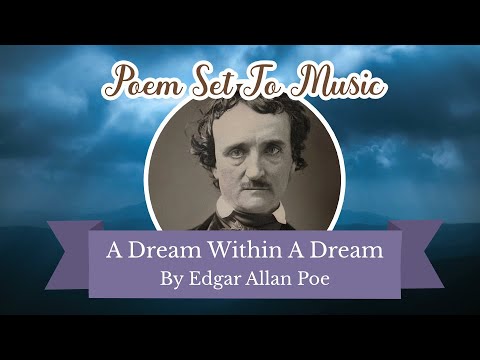
Edgar Allan Poe (1809 – 1849) was an American writer and poet known for his dark tales and horror stories. 

In Poe's famous poem A Dream Within a Dream the narrator deals with loss and despair and questions whether everything is real or just a dream. Read an analysis of this poem at Poemanalysis.

Instruments used in this song: female vocals, piano, electric piano and cello.

A Dream Within a Dream – Poem By Edgar Allan Poe

Take this kiss upon the brow!
And, in parting from you now,
Thus much let me avow—
You are not wrong, who deem
That my days have been a dream;
Yet if hope has flown away
In a night, or in a day,
In a vision, or in none,
Is it therefore the less gone?
All that we see or seem
Is but a dream within a dream.

I stand amid the roar
Of a surf-tormented shore,
And I hold within my hand
Grains of the golden sand—
How few! yet how they creep
Through my fingers to the deep,
While I weep—while I weep!
O God! can I not grasp
Them with a tighter clasp?
O God! can I not save
One from the pitiless wave?
Is all that we see or seem
But a dream within a dream?

🎵 Buy track on Bandcamp

🧑 Read a short biography about Edgar Allan Poe

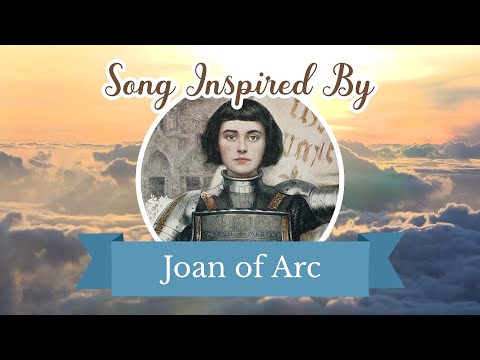
The true story of Joan of Arc (Jeanne d'Arc in French) is a fascinating one. Already a legend during her lifetime, she continues to inspire movies, music and other artistic works 600 years after her death. How did an illiterate peasant girl become the national heroine of France?

When Joan was about thirteen years old she started to get visions and hearing voices. Joan believed that these voices were messages from God and they would urge her to lead the French army during the Hundred Years’ War.

Under Joan’s leadership the French triumphed against the English during the siege of Orléans. About two years after this victory Joan was captured by the enemy and executed in 1431 at the age of nineteen.

In 1920 Joan was canonized and officially became a recognized saint by the Catholic church. She is the patron saint of France, prisoners, soldiers (particularly women) and those who face ridicule for their faith.

When I composed this song Joan’s fearlessness, determination and unshakeable faith served as the inspiration. This song was produced for a music production class and it’s my most ambitious track to date. It was my first time working on a project with this many tracks and I think the song works even without vocals so I made an instrumental version as well, watch it on Youtube

Lyrics

They say there's a story in everyone 
When the time comes you'll know what's to be done 
The sky opened up when mine begun 
It's my calling it's where I belong

They say there's a storm in everyone
It’s yours to discover yours to become
Hear my prayer hear my song 
We will be free so let’s march on

We must dare until the battle's won
When danger comes we won't run

When it begun sky opened up 
Heavenly voices from above 
And this light feels like home 
Warm and bright just like the sun 
I believe this is where I belong
Trust this light let it lead me on

I raise my banner in the air 
I trust I believe I dare 
I will dare until the battle's won
When danger comes I won't run

They say there's a story in everyone 
When the time comes you'll know what's to be done

🎵 Buy track on Bandcamp

🎵 Buy instrumental version on Bandcamp

👩 Read more about Joan of Arc on Wikipedia
The Flight is a poem about companionship by the American poet Sara Teasdale (1884 – 1933). There are two different poems by Teasdale both named The Flight, this version was printed in 1924 (source Poetryfoundation). 

I kept the arrangement very simple in this track, the only instruments used are a classical guitar, an electric guitar and my vocals.

The Flight  - Poem By Sara Teasdale

We are two eagles
Flying together
Under the heavens,
Over the mountains,
Stretched on the wind.
Sunlight heartens us,
Blind snow baffles us,
Clouds wheel after us
Ravelled and thinned.

We are like eagles
But when Death harries us,
Human and humbled
When one of us goes,
Let the other follow,
Let the flight be ended,
Let the fire blacken,
Let the book close.

🎵 Buy track on Bandcamp
👩 Read a short biography about Sara Teasdale

"A Red, Red Rose" is a famous romantic poem by the Scottish poet and lyricist Robert Burns (1759 – 1796). In this poem the speaker expresses their undying love for his bonnie lass, comparing her to a red rose and a sweet melody.

This poem has been set to music by many composers, the most popular version is the setting to the traditional tune "Low Down in the Broom". I really like this poem and I wanted to see if could come up with my own melody for it. So this is my version of “A Red, Red Rose” it’s a bit more upbeat than the traditional tune.

"A Red, Red Rose" - Poem By Robert Burns 

O my Luve is like a red, red rose
   That’s newly sprung in June;
O my Luve is like the melody
   That’s sweetly played in tune.

So fair art thou, my bonnie lass,
   So deep in luve am I;
And I will luve thee still, my dear,
   Till a’ the seas gang dry.

Till a’ the seas gang dry, my dear,
   And the rocks melt wi’ the sun;
I will love thee still, my dear,
   While the sands o’ life shall run.

And fare thee weel, my only luve!
   And fare thee weel awhile!
And I will come again, my luve,
   Though it were ten thousand mile.

🎵 Buy track on Bandcamp

🎸Download guitar chords (available for select membership tiers)

🧑Read a short biography about Robert Burns

John Keats (1795 – 1821) is one the most famous and loved poets from the British Romantic Era. In 1818 he met and fell in love with a young woman named Fanny Brawne. The couple became secretly engaged and during the short time they knew each other many romantic notes were exchanged between the sweethearts. The letters from John to Fanny have become some of the most famous love letters ever written.

On October 13th 1819, John wrote:

“I have been astonished that men could die martyrs
for their religion–
I have shuddered at it,
I shudder no more.
I could be martyred for my religion.
Love is my religion
and I could die for that.
I could die for you.”

This song is inspired by this quote and the beautiful movie Bright Star (2009) which depicts John and Fanny’s romantic relationship. Sadly John died aged 25 of tuberculosis before they could start a future together.

Instruments used in this track: Piano and female vocals.

Lyrics:

I shudder no more
At martyrs no more
I have been astonished that men can die
For religion give up their lives 
But I could die for you
Yes I would die for you

I am astonished no more
Love is my religion now I know
I could be martyred for that
For my love for you for that 
I could die for you
Yes I would die for you

I shudder no more
At martyrs no more
I am astonished no more
Love is my religion now I know
I could die for you
Yes I would die for you
I could die for you
Yes I would die for you

🎵 Buy track on Bandcamp

🧑 Read a short biography about John Keats